


Your Trusted Partners in Real Estate. Contact us at for all your property needs.
Moving from Edmonton to Victoria
A 2026 guide from Victoria REALTORS® who made the move themselves
We're Harrison Siemens and Corey Lister, REALTORS® with Caliber Property Group and Coldwell Banker Oceanside Real Estate. We both made our own moves to Victoria, and now we help people relocate here from across Canada. Before real estate, Harrison spent six years as a property appraiser.
For a lot of Edmontonians, the decision comes down to winter. Trading −15°C mornings and months of snow for green lawns in January, ocean air and a walkable, slower-paced city is a big draw, whether you're retiring, working remotely or just ready for a change.
Victoria costs more than Edmonton, especially for housing. But for many of our clients it's worth it, both for the lifestyle and as a long-term investment. This guide shows you how the prices compare, why Victoria homes hold their value, what changes when you move from Alberta to BC, and how to make your budget work here.
Home prices: a bigger step up, and worth it
Victoria is a premium market, and the gap with Edmonton is wider than with Calgary. A typical single-family home in Victoria's core costs about $760,000 more than one in the Greater Edmonton Area, based on each region's real estate board for September 2026, and condos cost roughly $350,000 more.
| Home type | Greater Edmonton | Victoria Core | Difference |
|---|---|---|---|
| Single-family house | about $519,000 | $1,280,100 | about $761,000 more |
| Condo / apartment | about $197,000 | $547,800 | about $351,000 more |
Benchmark (MLS® HPI) prices, September 2026. Sources: REALTORS® Association of Edmonton and Victoria Real Estate Board.
Why Victoria homes hold their value
- Victoria can't grow outward. The city is surrounded by ocean on three sides, with the Malahat and protected farmland limiting expansion to the north and west.
- Edmonton can. Edmonton sits on open prairie and keeps adding new neighbourhoods at its edges, so new supply can keep pace with demand.
- Demand keeps coming. People move to Victoria from across Canada every year for the climate, the lifestyle and retirement.
Limited land plus steady demand is why Victoria has a strong long-term track record of appreciation, and why we expect prices to keep rising over time. No one can promise where the market goes in any single year, but constrained supply has historically worked in Victoria owners' favour.
How Edmontonians make it work:
- Look at the West Shore. Langford, Colwood and Sooke offer newer homes and more space for the money, 20 to 40 minutes from downtown.
- Consider a townhouse, condo or a home with a suite. A legal suite can help carry the mortgage.
- Buy based on value. Harrison is a former property appraiser, so we can show you how any home's price compares to recent sales before you make an offer.
Cost of living: what changes from Alberta to BC
A few costs are different on this side of the Rockies, so it helps to plan for them early.
- Property transfer tax. Alberta has no land transfer tax, but BC does: 1% on the first $200,000 and 2% on the portion up to $2 million. On a $1,280,000 Victoria house that's about $23,600, due on closing. First-time buyers can save up to $8,000 on homes under $835,000. (Zealty)
- Rent while you look. A two-bedroom apartment averages $2,640 a month in asking rent in Victoria, versus $1,570 in Edmonton. (Statistics Canada, Q2 2026)
- Income tax. Provincial rates differ, and which province comes out ahead depends on your income. A quick call with your accountant before you move is worth it.
What you save: snow tires, block heaters, remote starters, and the winter heating bills that come with Edmonton's cold.
Your Edmonton-to-Victoria moving checklist
- Health coverage (MSP). Apply for BC's Medical Services Plan after you arrive. Coverage starts after the rest of the month you arrive plus two months, so keep your Alberta Health Care coverage until then. (BC Government)
- Driver's licence. You have 90 days to exchange your Alberta licence for a BC licence through ICBC. (ICBC)
- Car insurance and registration. BC's basic car insurance comes from ICBC, not private insurers, so plan to register and insure your vehicle here.
- Family doctor. Sign up with BC's Health Connect Registry soon after you arrive.
- Property transfer tax. Budget for it on your purchase (see above).
- The drive or the flight. Driving from Edmonton? Book your BC Ferries crossing to Swartz Bay ahead of time, especially with a moving truck.
Climate: from −15°C to green in January
This is the change Edmontonians feel first. Victoria's January highs average about 9°C, compared with −6°C in Edmonton, and Victoria gets about 33 cm of snow a year on roughly 7 days, versus 124 cm over 52 days.
| Edmonton | Victoria | |
|---|---|---|
| January average high / low | −6°C / −15°C | 9°C / 4°C |
| Snowfall per year | 124 cm | 33 cm |
| Days with snowfall | 52 | 7 |
Environment Canada climate normals, 1981–2010, via Current Results.
And Victoria isn't the rainy West Coast you might picture. It sits in the rain shadow of the Olympic Mountains and gets about half of Vancouver's yearly precipitation: 705 mm versus 1,457 mm. Daily Hive, citing Environment Canada data, puts Victoria's sunshine at the equivalent of about 308 sunny days a year. (Current Results, Daily Hive)
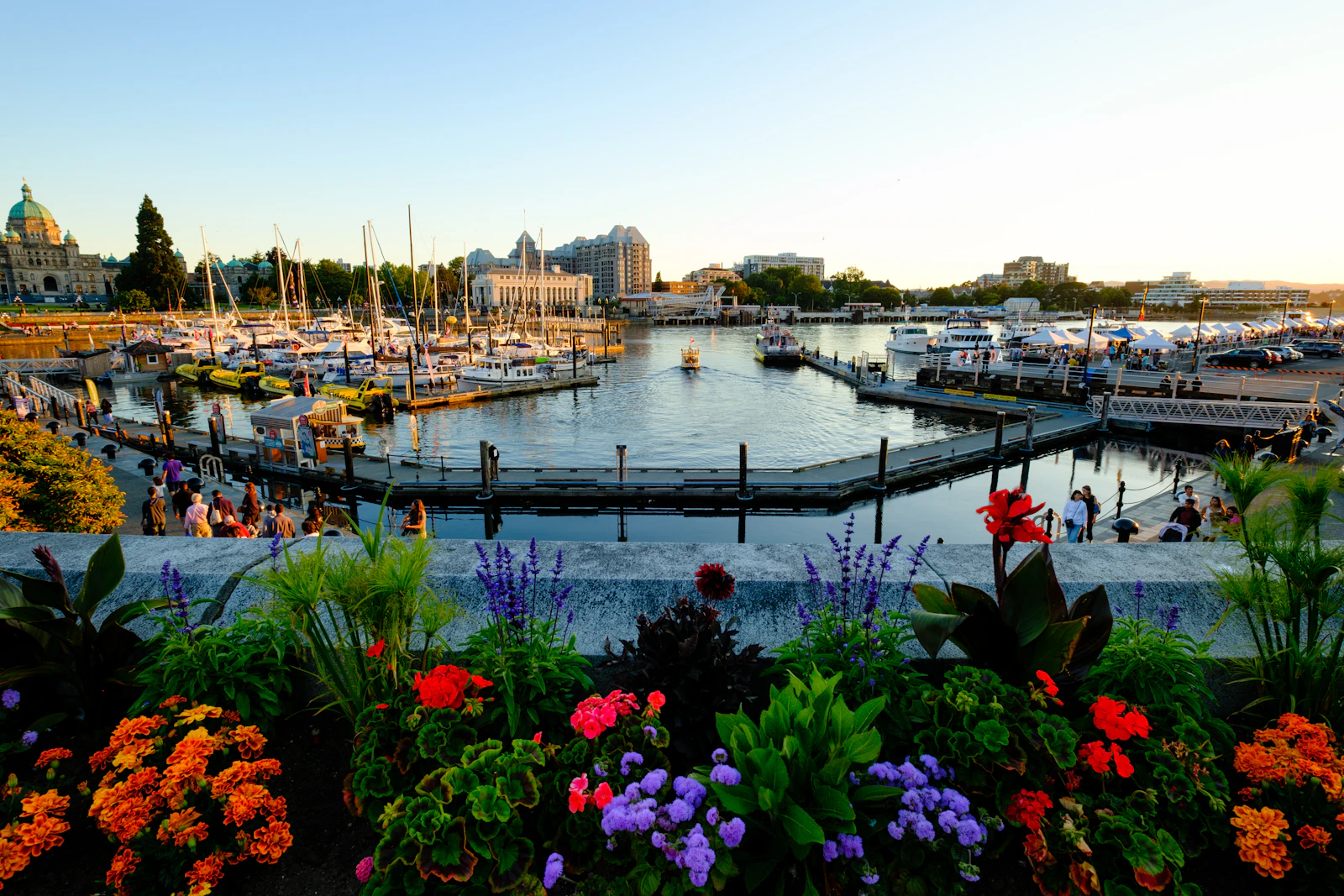
Gardens stay green through winter, cherry blossoms arrive early, and the seawall is walkable year-round.
Getting around and staying close to Edmonton
Victoria is compact. It had the shortest average commute of the eight cities in Statistics Canada's latest commuting study, at 20.5 minutes (May 2024), and downtown, the University of Victoria and the beaches are all about 20 minutes from most neighbourhoods. (Statistics Canada)
Victoria International Airport has direct flights to Edmonton, so visiting family, grandkids or old friends is a quick trip rather than a long drive through the mountains.
Lifestyle: river valley to oceanfront
If you love Edmonton's river valley trails, you'll find Victoria's version is right on the water, and open all year.
- Year-round outdoors. Golf, cycling and hiking keep going through winter.
- Lakes and trails nearby. Thetis Lake, Elk and Beaver Lake and Mount Douglas are 15 to 20 minutes from downtown; Goldstream Provincial Park is about 25.
- The ocean. Kayaking from the Inner Harbour, whale watching, and walks along Dallas Road.
- Festivals and food. If you'll miss Whyte Avenue and Edmonton's festival season, Victoria has a busy summer of its own, plus a strong local food and craft brewery scene.
What surprises people moving from Edmonton
- The price of land. Lots are smaller and price per square foot is higher. Most clients find the climate, location and long-term value make up for it.
- Older homes. Much of Victoria's housing dates from the 1950s to the 1980s, so inspections and an eye for value matter more. Harrison's appraisal background helps here.
- How mild winter is. Your first January without a parka, block heater or shovel takes some getting used to, in the best way.
- The pace. Things are calmer, and many shops close earlier.
Which Victoria neighbourhood matches your Edmonton one
| If you love… | Look at… | Why |
|---|---|---|
| Old Strathcona or Whyte Avenue | Fernwood, Cook Street Village | Walkable, cafés, character homes |
| Downtown or Oliver condos | Downtown, James Bay | Condo living close to the harbour |
| Newer suburbs (Windermere, Summerside) | Langford, Colwood, Royal Bay | Newer homes, more space for the money |
| Glenora or Belgravia | Oak Bay, Rockland | Mature trees, heritage homes, oceanside |
| St. Albert or Sherwood Park | Saanich, Sidney | Family-friendly, quieter, close to the city |
Frequently asked questions
Is Victoria more expensive than Edmonton?
Yes, especially for housing. In September 2026 a benchmark single-family home cost $1,280,100 in Victoria's core versus about $519,000 in the Greater Edmonton Area. Victoria's limited land, surrounded by ocean on three sides, and steady demand from people moving here from across Canada have long supported its home values.
How cold does Victoria get in winter?
Not very. January highs average about 9°C in Victoria, compared with −6°C in Edmonton, and Victoria averages about 33 cm of snow a year on roughly 7 days.
Do I pay property transfer tax when I buy in Victoria?
Yes. Unlike Alberta, BC charges property transfer tax: 1% on the first $200,000 and 2% up to $2 million, or about $23,600 on a $1,280,000 home. Eligible first-time buyers can save up to $8,000.
How long do I have to switch my Alberta driver's licence?
You have 90 days after moving to BC to exchange it for a BC licence through ICBC.
When does BC health coverage start?
MSP coverage begins after the rest of the month you arrive plus two months. Keep your Alberta coverage during that wait.
Are there direct flights between Victoria and Edmonton?
Yes. Victoria International Airport has direct flights to Edmonton, which makes visiting family easy.
Can I buy a Victoria home before I move?
Yes. You can start remotely: we can send video walkthroughs and recent comparable sales for homes you like, then you visit for a focused weekend of showings.
Thinking about the move?
Moving provinces is a big step, and we'd be glad to help you plan it. Call or text Harrison at 778-966-1078 or Corey at 250-709-3753, or email harrison@caliberpropertygroup.ca, and we'll talk through neighbourhoods, budget and timing, even before you visit.
Prices and rents last updated October 2026. Photos via Unsplash: Vlad D, Jason Scheibelhofer, Sharissa Johnson.